Populating SBOM License Fields From Nix Package Metadata
Nix package metadata provides structured license data for compliant SBOMs.
The 2026 CISA Minimum Elements, version 2.1, published 29 July 2026 alongside partner agencies from multiple countries, raised the bar for what counts as a complete SBOM, adding ten new required fields to the seven carried over from the 2021 NTIA baseline. Component License sits among those ten additions and had no equivalent in the 2021 NTIA document at all. The guidance is specific about form: license data has to appear in machine-processable form wherever possible, preferably as SPDX license identifiers, proprietary conditions need to be flagged, and a URL fallback applies where no identifier exists.
Two other new fields tie directly into license integrity. Component Hash Value and Component Hash Algorithm together let a consumer confirm that the artifact a license claim describes is the artifact actually in use. SBOM Author Signature, also new in 2026, requires a digital signature attributable to the SBOM author, pointing to NIST DSS, ISO/IEC 14888-4:2024, and ENISA's Agreed Cryptographic Mechanisms. SBOM Generation Context, also new, records where in the build lifecycle the SBOM was produced, before build (source), at build, or after build (binary analysis), because license field completeness depends heavily on which phase the SBOM was generated.
None of this is theoretical at this point. CRA reporting obligations began on 11 September 2026, so the compliance clock is already running rather than pending. The guidance's preference for SPDX identifiers as the machine-processable target raises an immediate practical question: where do teams actually get those identifiers from, in a form clean enough to drop into an SBOM without manual cleanup?
N|Producing machine-processable SPDX license identifiers at scale is harder than it sounds
SPDX itself is a mature standard. Developed by the Linux Foundation's SPDX workgroup and recognized as ISO/IEC 5962:2021, with version 3.0.1 published in December 2024, it started as a license-compliance format and has since grown into a broader supply-chain transparency and security standard. Its identifier vocabulary is exactly the machine-processable form the 2026 guidance calls for. The standard is not the bottleneck.
The bottleneck sits upstream, in how license information gets into a build in the first place. Most build systems carry no structured license metadata alongside the artifact they produce. License data has to be scraped after the fact from source files, README text, or package manifests, and the resulting field is only as reliable as the scraping heuristic that produced it. Post-hoc binary analysis, the "after build" generation context in the CISA taxonomy, is the lowest-fidelity option the guidance itself recognizes. It has a use case when a team does not control the build, but it inherits every limit that static analysis carries.
That produces a specific gap: a license field populated from a binary scan reflects what a tool guessed about the component, not what the component's producer actually declared. Eliminating exactly that gap is the point of the machine-processable requirement in the 2026 guidance. SPDX 3.0 added a dedicated Licensing profile to handle common license-compliance use cases, and teams choosing tooling now have to work out which SPDX version and serialization their downstream consumers can actually ingest. Solving the format problem doesn't solve the sourcing problem. License metadata needs to exist in structured form before the SBOM generator ever runs, and that's a build-system property, not a tooling choice.
N|Nix derivations carry structured license metadata as a first-class build artifact
Nix treats a derivation as the fundamental unit of a build. A derivation specifies the builder, the system type, its arguments, and a complete, explicit set of inputs, and the build itself runs in a sandbox that blocks network access and strips host environment variables. O|The same inputs reproduce the same result at any point in the future. That reproducibility guarantee is the foundation for everything that follows, because it means metadata attached to a derivation describes a build that can be regenerated identically rather than a one-off artifact whose provenance fades over time.
Every nixpkgs package carries a meta attribute set that includes license, maintainers, homepage, and a description. These fields travel with the derivation itself, not bolted onto the compiled binary as an afterthought. Because Nix stores packages in unique, hash-addressed directories whose names encode every input, including other packages the build depends on, the license metadata attached to a given derivation is cryptographically bound to that exact build. It cannot silently drift to describe a different version of the component down the line.
Nixpkgs holds a very large number of packages, and continuous integration through Hydra builds them for x86-64 and ARM on both Linux and Darwin before uploading the results to a public binary cache. License metadata gets exercised at scale, across architectures, well before a developer ever touches the package. CISA's own terms identify this as the "build" generation context, the option the 2026 guidance identifies as highest-fidelity for SBOM generation. The license field comes from declared, structured metadata captured at build time rather than reconstructed afterward by a scanner making its best guess.
That strength comes with a caveat worth stating now rather than later. The meta.license field is declared by a package maintainer, and its accuracy depends on the rigor of that declaration, not on an independent check against the actual source code. The mechanism that makes Nix's license metadata structurally sound doesn't make it automatically correct, and that distinction becomes the central objection to the whole approach further down.
N|The sbomnix toolchain maps nixpkgs metadata to SPDX and CycloneDX license fields
Getting that structured metadata out of a derivation and into a standards-compliant SBOM is the job of sbomnix, a toolchain developed by the Technology Innovation Institute (tiiuae). B|sbomnix enriches SBOMs with nixpkgs metadata, descriptions, licenses, maintainers, and homepage links when the build target is a flake reference, and outputs both SPDX and CycloneDX, the two formats the 2026 guidance accepts.
F|The flake reference makes this work. Pointed at one, sbomnix can resolve the exact nixpkgs version used to build the package and pull descriptions, licenses, maintainers, and homepage links from structured metadata rather than scraping them from source. That resolution depends on the flake.lock file, which records the exact commit hash, or rev, for every input the flake declares. Committing that lock file to Git means the license metadata visible in a developer's local shell matches, field for field, what CI reports in the generated SBOM. Drift between the two becomes structurally impossible rather than merely unlikely.
The output carries its own paper trail. CycloneDX and SPDX documents from sbomnix record the metadata source directly in document metadata, with fields including nixpkgs:metadata_source_method, nixpkgs:path, nixpkgs:rev, nixpkgs:flakeref, nixpkgs:version, and nixpkgs:message. An auditor can trace any license field back to the exact nixpkgs commit it came from.
M|The identifier-matching logic degrades gracefully instead of failing. When nixpkgs metadata is available, sbomnix prefers an exact CPE identifier sourced from nixpkgs itself, and only falls back to heuristic CPE matching when no exact identifier exists. The --exclude-cpe-matching flag turns off just that heuristic fallback, while --exclude-meta disables nixpkgs metadata sourcing entirely. Beyond license fields, sbomnix's provenance command generates SLSA v1.0 compliant attestation files in JSON for any Nix flake or derivation, which speaks directly to the SBOM Author Signature and generation-context requirements in the 2026 guidance. The project publishes CycloneDX and SPDX SBOMs for its own releases in its release assets, applying the same workflow to itself that it offers to everyone else. By default the SBOM covers runtime dependencies, nixgraph graphs those same runtime dependencies, and vulnxscan and nix_outdated scan them for known vulnerabilities.
G|The store-path blind spot for teams using binary caches
C|The workflow has a clear failure mode that appears the moment a team bypasses flake references. Store-path targets, meaning pre-built Nix store paths pulled from a binary cache with no corresponding flake reference, give sbomnix no nixpkgs metadata source to work from. In that situation, --exclude-cpe-matching typically strips CPEs from those targets entirely.
Teams that consume packages primarily through binary caches, without pinning a flake reference for what they pull, lose the automatic license enrichment that makes the Nix-to-SBOM pipeline worth building in the first place. K|The flake reference is a required mechanism here. It's the mechanism that connects a store path back to the specific nixpkgs commit carrying the meta.license attribute, and without it there is nothing for sbomnix to enrich against.
This blind spot sits inside a larger visibility gap that Nix environments have carried for a while: vulnerability tracking across Nix-based systems has historically lagged behind other ecosystems, though the Manifest Platform now provides automated vulnerability mapping for Nix packages, giving security teams a way to track known vulnerabilities across Nix environments. The store-path gap is a solvable process problem: pin the flake reference, and the enrichment follows. A separate and more fundamental question remains open regardless of how a team sources its packages, namely whether the declared metadata itself can be trusted.
G|The declared-versus-verified objection and the preloop approach
The most serious challenge to this entire approach is straightforward to state. The meta.license field in nixpkgs is declared by a package maintainer, not validated against the component's actual source code, so any license field sbomnix produces inherits the accuracy of community curation rather than a ground-truth scan. A maintainer can mislabel a license, miss a dependency's separate licensing terms, or simply fall behind when a project's terms change. Structured metadata is only as good as the discipline behind it.
A recent development in the preloop project offers a partial, concrete answer without pretending the question is closed. Pull request 1021 on preloop/preloop, from September 2026, added a large offline derivation path combining an SPDX expression parser with license-text header rules. P|It writes license data into release SBOMs and stamps a declared-licenses entry onto SBOM components that lack one when a local source, such as a Python METADATA file, an npm package.json, a Go module-cache LICENSE file, or the Go standard library, names exactly one SPDX ID or expression that validates against a vendored SPDX 3.27.0 list. Where a declaration is ambiguous or conflicting, the tool leaves the field blank rather than guessing. That design choice, a known gap over a plausible-looking wrong answer, is the right instinct for a compliance artifact that auditors will actually read.
The counter-argument to the declared-versus-verified objection turns on what "machine-processable" is meant to achieve. A declared license tied to a known, pinned nixpkgs commit hash is already considerably more auditable than a post-hoc binary scan with no traceable origin at all. The 2026 guidance's machine-processable requirement is fundamentally about traceability, and a pinned declaration from a known source beats a heuristic guess on that measure even when the underlying declaration itself hasn't been independently verified. For teams under HIPAA, FedRAMP, or comparable regulated obligations, the right approach is to layer source-level license scanning on top of nixpkgs metadata as a verification step, using the nixpkgs:rev field in sbomnix's output to identify precisely which version of each package needs that scan.
Putting the pipeline together: from flake reference to audit-ready SBOM license field
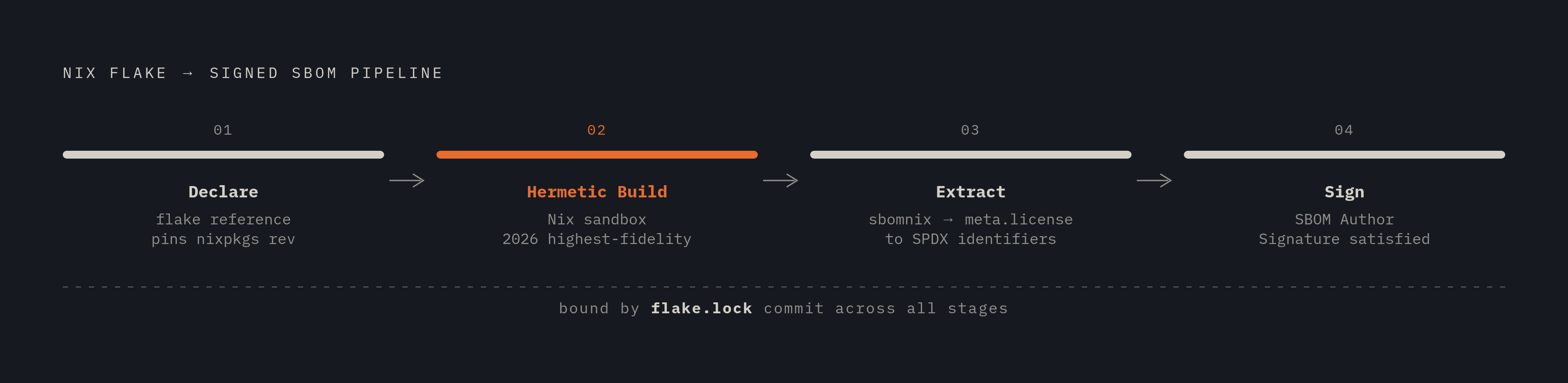
Stitched together, the mechanisms above form a pipeline with four identifiable stages. First, declare the environment with a flake reference, pinning the nixpkgs rev. Second, build inside Nix's hermetic sandbox, which satisfies the "build" generation context the 2026 guidance treats as highest-fidelity. Third, run sbomnix against that same flake reference to extract meta.license into SPDX identifiers. Fourth, sign the resulting output, satisfying the SBOM Author Signature requirement.
The artifact that holds the whole chain together is the flake.lock commit. It ties every license field in the eventual SBOM to a specific, reproducible nixpkgs state, and committing it to the same repository as the application code means those license fields are version-controlled right alongside the software they describe. An auditor reviewing a release six months later can check out the same commit and reproduce the same SBOM, license fields included.
Environment management tools built on Nix's declarative model, particularly ones offering a human-readable manifest and support for sharing a named environment across a team, can turn this pipeline into a property of the environment itself rather than a bolted-on CI step. Every developer who activates that environment gets the same pinned nixpkgs state that CI uses to generate the SBOM, so the license fields end up identical by construction instead of by process discipline that has to be maintained and audited separately. The same flake.nix or equivalent manifest that speeds up onboarding for a new engineer is the file that makes license-complete SBOM generation possible in the first place. A|Compliance becomes a direct byproduct of the investment already made in developer experience, rather than a parallel audit exercise bolted onto development. Because that manifest is shared, whatever a developer sees locally is what CI will see too.
Most organizations generate their actual SBOMs in CI, not on a developer's laptop, which makes CI the place where the pipeline described above either holds together or quietly falls apart. The failure mode is familiar to anyone who has debugged a "works on my machine" ticket: a developer's local environment drifts from what CI resolves, dependency versions shift between the two, and the SBOM that ships describes a slightly different build than the one a developer actually tested.
Nix's pinning model closes that gap at the source rather than papering over it after the fact. Because flake.lock records the exact commit hash for every input, and that file lives in version control alongside the code, CI resolves precisely the same nixpkgs state a developer's shell resolves. There is no separate "CI configuration" for dependency versions that can quietly diverge from what's declared in the repository. The SBOM that CI generates on merge describes the identical set of packages, at the identical pinned revisions, that a developer built and tested locally.
That consistency matters most at the exact moment license data changes: when a dependency gets bumped. Because the bump happens through an update to flake.lock, itself a reviewable, diffable Git change, a pull request that changes a dependency version is also, transparently, a pull request that can change a license field in the next generated SBOM. Reviewers see the version bump and the metadata consequence in the same diff, rather than discovering a license change weeks later when an SBOM lands on an auditor's desk with a field nobody remembers updating.
Sources
- Nix (package manager)
- Software Package Data Exchange
- sbom: fill component licenses from package metadata so the license flag clears by d-mo · Pull Request #1021 · preloop/preloop
- GitHub - tiiuae/sbomnix: SBOM, provenance, dependency graph, and vulnerability tools for Nix. · GitHub
- C/C++ SBOMs, Nix Security, and Supply Chain Visibility
- FOSDEM 2026 - Nixpkgs Clarity: Correcting Nix package license metadata
- 2026 Minimum Elements for a Software Bill of Materials ( ...