License Compliance Extraction From Nixpkgs Meta.license
Nixpkgs attaches a structured license record to nearly every package it builds, queryable at evaluation time through meta.license. That record is more useful than most package ecosystems offer, though compliance teams often assume it is more complete than it actually is.
What meta.license is and what it gives you out of the box
Nixpkgs treats license status as data, not documentation. Each package carries a meta.license record with discrete fields: spdxId, fullName, free, redistributable, url, shortName, and deprecated. Because these fields are structured rather than freeform text, they can be filtered, queried, and audited programmatically across the entire package set.
The Nixpkgs Reference Manual exposes lib.meta.getLicenseFromSpdxId as the mapping function between SPDX ID strings and those structured records. That mapping matters because it turns a license name into something a build system can act on: a package's free field isn't just a label. Nix refuses, by default, to evaluate unfree packages unless a user explicitly opts in, which gives that field enforcement behind it rather than just descriptive value.
For a package manager handling tens of thousands of packages, this is a genuinely useful foundation. A team auditing dependencies can, in principle, walk the entire dependency graph and ask, package by package, what license applies and whether that license is free or redistributable, without opening a single source tree. Few ecosystems offer anything close to this at evaluation time. A compliance workflow could be built on that foundation, and the gaps in that data matter as much as they do because of it.
The three structural gaps that make raw meta.license data untrustworthy on its own
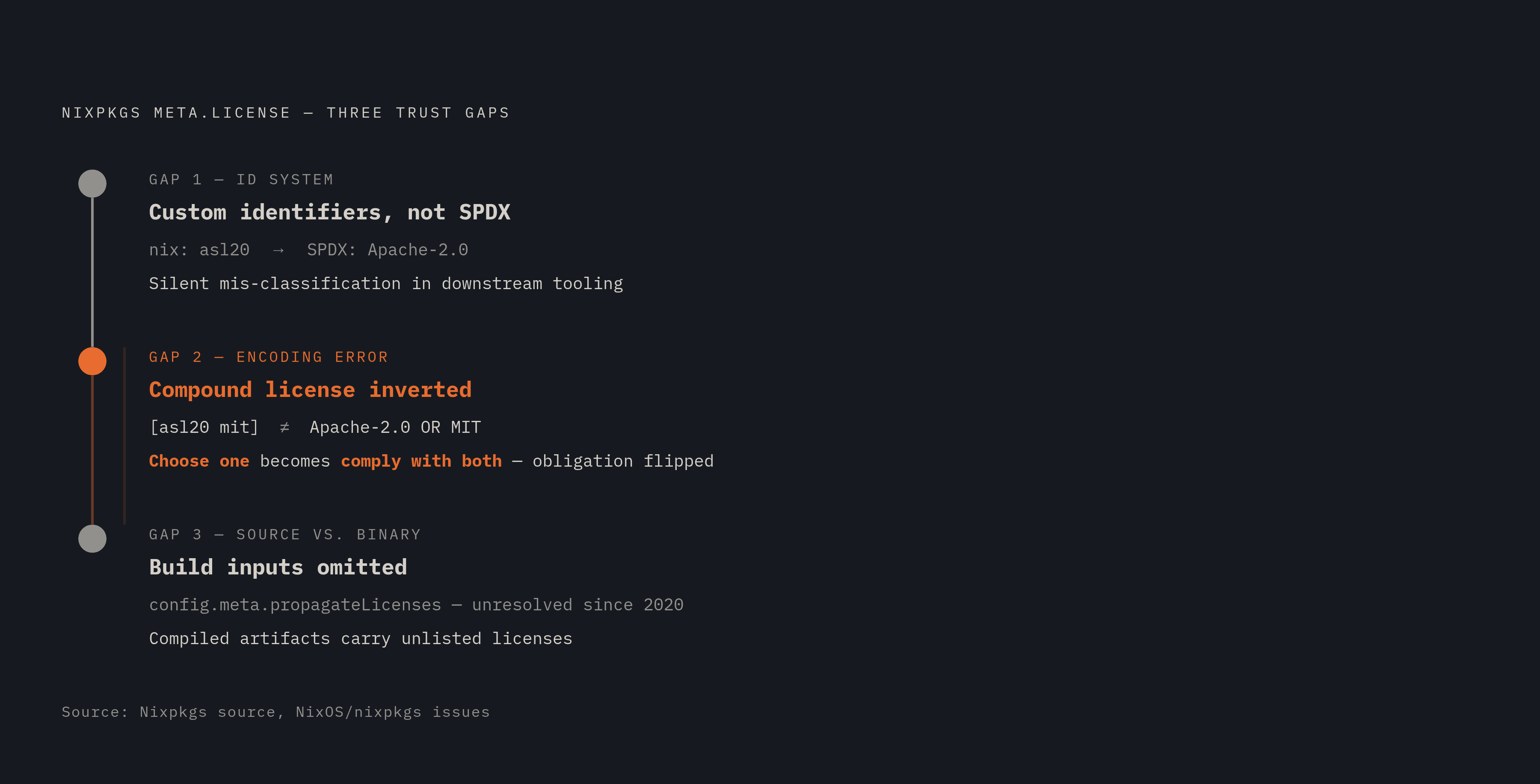
Three distinct, independently checkable problems limit how far the mechanism can be trusted on its own: a custom identifier system that diverges from SPDX, systematic misuse of the list form for compound licenses, and a structural gap between what source code declares and what a built binary actually contains.
Nix's license tracking uses a custom ID system that doesn't match SPDX best practices, referencing SPDX identifiers inconsistently alongside ScanCode LicenseDB conventions. Tooling built on the assumption that Nixpkgs speaks clean SPDX will silently mis-classify packages as a result. Compounding this, packagers typically check only the top-level declared license and skip file-level detail, so the metadata drifts out of sync with the actual code over time.
Structural misuse of compound expressions is the second problem. A Nixpkgs Architecture discourse thread on compound licenses, dated June 24, 2026, documented that many packages dual-licensed as "Apache-2.0 OR MIT" get assigned meta.license = with lib.licenses; [ asl20 mit]. The list form was designed to enumerate licenses covering different parts of a package, not to express a choice between alternatives. Encoding a choice as a list flips the obligation entirely: automated tooling reading that list concludes the licensee must comply with both licenses simultaneously, when upstream actually grants the licensee a choice of either one. That's not a cosmetic error. It changes what a downstream user is legally required to do.
The third problem lies in the gap between source license and compiled binary. Packagers declare the license that applies to the source tree, but what applies to a compiled artifact depends on native build inputs that can't be fully resolved at evaluation time. A Hacker News thread on Nixpkgs reproducibility pointed out that even a fully reproducible build can't guarantee the absence of binary blobs; the package manager has no way to be certain none are embedded. That's precisely the category meta.license cannot capture, because it describes source declarations, not what ends up baked into an artifact. A long-standing GitHub issue proposes a config.meta.propagateLicenses switch that would carry build-input licenses through the derivation graph, a design question that has sat unresolved since at least 2020. Until it's resolved, any SBOM built from meta.license alone under-counts binary-artifact obligations, systematically and by design, not by accident.
Each is independently checkable, and each has a known mitigation, covered later in this piece. But a practitioner who treats raw meta.license output as authoritative, without accounting for these three gaps, is working from a map that quietly omits three categories of terrain.
The mismatch problem, shown through the September 2026 tracking issue
These aren't hypothetical failure modes. A systematic comparison of declared meta.license values against the licenses actually stated in upstream repositories, now tracked publicly, found roughly a thousand potential mismatches across packages that use fetchFromGitHub.
That comparison lives in GitHub issue #564638, opened September 18, 2026, the first community effort to enumerate and resolve discrepancies of this kind at this scale. The issue carries the label severity: legal, which signals something beyond bookkeeping: the Nixpkgs community now treats license accuracy as a correctness problem on par with build reproducibility, not a documentation nicety to clean up when time allows.
One example from the tracking issue makes the stakes concrete. The package python3Packages.skytemple-rust had its license set to MIT, while both the upstream LICENSE file and its Cargo.toml manifest declare GPL-3.0-or-later. For a hobbyist, that's a metadata bug. For a commercial user relying on meta.license to confirm a package carries permissive terms, that's a compliance failure baked into a shipped artifact.
The scale of the problem doesn't mean automated detection has solved it. The tracking issue's own authors note that the mismatch list still contains a significant share of false positives, so fully automated license extraction can't be treated as authoritative on its own. Every flagged mismatch needs a human to check it against upstream before anyone files a correction. That qualification matters as much as the thousand-mismatch figure itself: the scale confirms the problem is real and current, and the false-positive rate confirms that the fix isn't a script you run once and trust forever.
The EU Cyber Resilience Act makes these accuracy gaps a legal exposure
For any company shipping a product built on Nixpkgs, these gaps stopped being a quality-control annoyance on September 11, 2026, when the first implementation stage of the EU Cyber Resilience Act took effect. The obligation to get license and provenance data right now sits with the manufacturer placing the product on the market, not with Nixpkgs maintainers.
The CRA's vulnerability-reporting regime runs on tiered deadlines: a 24-hour initial notification, a 72-hour follow-up, and a final report on a longer timeline for severe incidents. Meeting those deadlines requires a manufacturer to reliably associate a disclosed vulnerability with the specific library it affects, a task that becomes structurally harder when the license and provenance metadata describing that library is miscategorized or incomplete. A team that can't quickly confirm which license governs a dependency is also, in most cases, a team whose broader provenance data isn't reliable enough to trace an exploited vulnerability back to its source inside a 24-hour window.
The CRA also requires manufacturers to identify and document at least their top-level dependencies in a commonly used, machine-readable format. In practice, that means SPDX or CycloneDX, with SWID also qualifying under the regulation's standard for acceptable formats. All three formats depend on accurate per-package license data to be useful for anything beyond a checkbox exercise. Feeding a CycloneDX document with mis-encoded compound licenses or stale top-level declarations doesn't produce a compliant SBOM; it produces a document that looks compliant until an auditor or a regulator checks it against upstream.
A second compounding factor makes this harder still. Without both accurate license data and CPE coverage, a CRA-compliant SBOM can't be generated from Nixpkgs metadata alone, no matter how carefully the license fields are queried.
One part of this remains genuinely unsettled rather than simply unresolved by policy neglect. Individual maintainers and non-commercial projects sit largely outside the CRA's scope, and open-source foundations acting as stewards face lighter obligations than commercial manufacturers. But the line between "steward" and "manufacturer" is contested, and a company that both contributes upstream to Nixpkgs and ships a commercial product built on it can't assume which side of that line it falls on. That ambiguity is a real compliance risk for exactly the kind of organization likely to be reading Nixpkgs metadata closely enough to notice these gaps in the first place.
Querying meta.license correctly
Each of the three structural gaps named earlier has a corresponding query pattern that avoids it. None require abandoning meta.license, only reading it correctly.
Fixing the compound-license misuse means no longer reading boolean fields directly, instead using the helper functions built to evaluate compound expressions correctly:
lib.licenses.isFree pkg.meta.license
lib.licenses.isRedistributable pkg.meta.license
These helpers handle expressions built with OR, AND, WITH, and PLUS correctly. A naive check like license.free or true against a compound attrset will silently mis-evaluate a license that's actually a choice between two permissive terms, or worse, misread a copyleft obligation as satisfied when it isn't [1][2]. The compound-licenses Discourse thread includes a worked example of the correct predicate pattern and documents the footguns; tooling that touches license data should reproduce the correct pattern in code.
For the list-versus-choice ambiguity itself, treat any package using the list form, meta.license = [ asl20 mit ]as a claim that different parts of the package carry different licenses rather than a claim that the licensee may pick one. If upstream's own documentation doesn't confirm that both licenses genuinely apply to different files, flag the package for manual review rather than trusting the encoding at face value.
For the source-versus-binary gap, no query pattern closes it, because the data simply isn't captured at evaluation time. Any tooling built on meta.license should state explicitly, in its own output, that the license data reflects source declarations and doesn't account for build-input license propagation, because every downstream consumer of that output needs to know the boundary of what it actually covers.
Verifying meta.license against upstream: the manual and automated steps that close the gap
Querying correctly gets a practitioner an accurate reading of what meta.license says. It doesn't confirm that what it says matches what's actually true upstream. Closing that second gap takes a verification workflow with both automated and manual steps, run in a specific order.
The most direct automated check available today is the same one behind GitHub issue #564638: scripting a comparison between a package's declared meta.license and the license stated in its upstream repository, for any package fetched with fetchFromGitHub. Running that comparison across a dependency set surfaces the obvious mismatches quickly and at scale.
That output isn't a finished answer. The false-positive rate in the existing comparison is high enough that every flagged mismatch needs manual confirmation against the upstream LICENSE file and any language-specific manifest, whether that's a Cargo.toml, a package.json, or a pyproject.toml, before anyone acts on it or files a correction.
Automated comparison also has a hard boundary of its own. Top-level meta.license never captures file-level licensing. Vendored dependencies, embedded fonts, bundled JS, or separately licensed test fixtures will not appear in top-level meta.license; tooling such as the automated detection approach used by Nixpkgs Clarity is needed for this layer. This is the layer where Nixpkgs Clarity, presented at FOSDEM 2026 by Philippe Ombredanne, does its work: applying automated license detection across the full Nixpkgs collection and correcting metadata to align with SPDX conventions. Nixpkgs Clarity is a community effort in active progress, not a finished, guaranteed-correct dataset, and practitioners are better served watching for its corrections landing upstream over time, or contributing to it directly, than assuming its output is already complete.
One more boundary matters for anyone building a verification pipeline. The fetchFromGitHub-based automated comparison only works for packages actually fetched that way. For everything else, verification has to be done by hand against the upstream source tarball or version-control history. A complete verification workflow can't be fully automated even after the tooling above is in place.
Generating a CycloneDX or SPDX SBOM from Nix that captures license data correctly
Once meta.license data has been queried with the right helpers and checked against upstream where it can be, the remaining step is getting that data into a format an auditor, a regulator, or an automated policy engine can actually consume.
Determinate Systems released FlakeBOM in June 2026 as a CLI available exclusively to Determinate Secure Packages customers that generates spec-compliant CycloneDX SBOMs from Nix flakes, fast enough to run on every build, and includes Vulnerability Exploitability eXchange (VEX) data for manually mitigated vulnerabilities, recommended workarounds, and other additional vulnerability information. It's fast enough to run on every build rather than as a periodic audit step, and it includes Vulnerability Exploitability eXchange (VEX) data covering manually mitigated vulnerabilities, recommended workarounds, and related vulnerability context. Its companion tool, FlakeAudit, enforces license policy through SPDX expressions, per-component bans with individual exceptions, and an allowlist of acceptable PURL ecosystems. License policy becomes something enforced at build time rather than something discovered during an after-the-fact audit.
The Nixpkgs Reference Manual references CycloneDX as an interoperability standard in its own right. Its buildNimSbom helper is a Nim-specific build tool that constructs Nim packages from existing CycloneDX SBOM files, not a general-purpose SBOM generator for arbitrary packages.
One structural property of Nix works in a compliance team's favor here. Because every Nix derivation is addressed by a hash of its inputs, the same meta.license value is structurally available for a given package regardless of which architecture it's built for. Cross-platform license audits don't require separate SBOM runs per target architecture, which removes a meaningful amount of duplicated work from multi-platform compliance pipelines. A team shipping the same product to x86_64 and aarch64 targets doesn't need to re-derive license data twice.
None of this closes the source-versus-binary gap named earlier in this piece. An SBOM generated from Nix metadata, however well-verified the license fields behind it are, still reflects source-declared licenses rather than what a compiled binary artifact actually contains. That scope limitation needs to be documented explicitly in the SBOM's own metadata fields, not left implicit, so that anyone consuming the SBOM downstream isn't misled about what it does and doesn't cover. A correctly queried, carefully verified meta.license field is a genuinely strong foundation for license compliance work. It was never built to be the entire structure on its own.
Sources
- FOSDEM 2026 - Nixpkgs Clarity: Correcting Nix package license metadata
- Tracking: Incorrect licenses · Issue #564638 · NixOS/nixpkgs
- Nixpkgs provides license[1] and source provenance[2] information. For legal reas...
- python3Packages.skytemple-rust: Fix license metadata by marius851000 · Pull Request #566565 · NixOS/nixpkgs
- Compound licenses - Nixpkgs Architecture - NixOS Discourse
- Nixpkgs Reference Manual
- License of package versus license of source/project and propagation of licenses · Issue #106471 · NixOS/nixpkgs