Verifying Upstream Nixpkgs Derivation Provenance Before Consuming It
Nix provides strong build guarantees but cannot verify that upstream code itself is trustworthy.
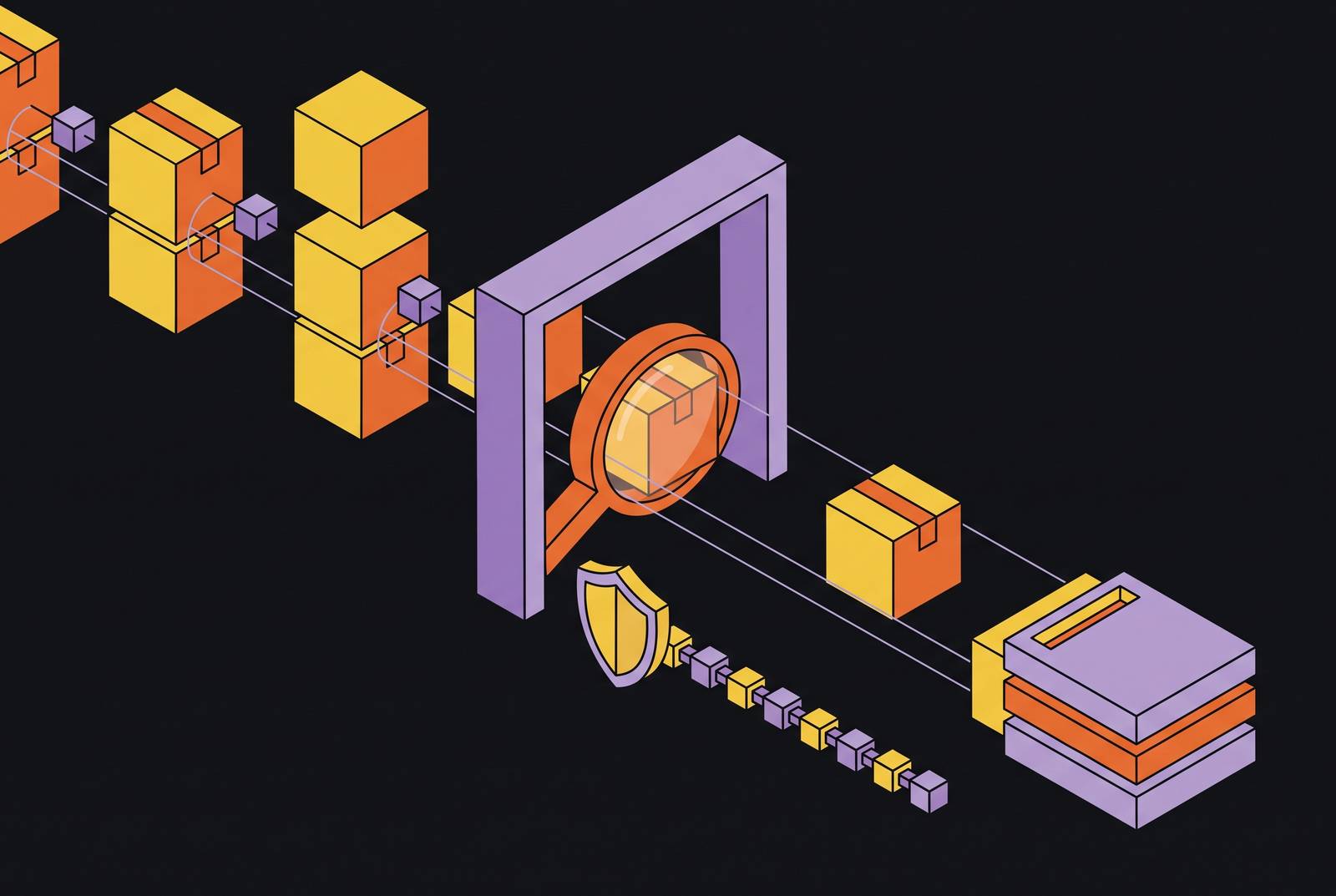
Verifying upstream Nixpkgs derivation provenance means establishing more than whether an artifact has the expected hash. Nix provides a structural head start through content-addressing, sandboxing, and auditable dependency closures, but those controls do not prove that a binary came from the claimed source and build process. Verification therefore needs several layers of checks before packages are used, then tracking and review as they move into production.
Why content-addressing alone does not constitute provenance verification
A Merkle tree provides the useful intuition for content-addressing. Each hash binds content into a chain, so changing a dependency changes its identity and breaks the expected chain upward. This makes silent substitution detectable against an independently trusted hash. Nixpkgs adds sandboxed builds with restricted network and filesystem access, while auditable closures expose build-time and runtime dependencies.
The boundary is between identity and provenance. An output hash establishes that received content matches the hashed artifact. A store path is not, by itself, evidence of build faithfulness.
Solarin et al. (arXiv 2026) distinguish reproducibility from verifiability on precisely this point. Reproducibility means the same source produces identical artifacts, while verification requires an independent party to recover the source revision, environment, dependencies, and instructions needed to reproduce the artifact. The study identifies Nix and Debian as centralized-build ecosystems that preserve or publish artifact-bound build specifications through ecosystem infrastructure. That gives them an advantage over decentralized ecosystems such as npm and PyPI, but does not automatically establish provenance.
The three structural gaps that content-addressing leaves open
Fixed-output derivations create the first gap in the build boundary. These derivations permit network fetches during a build and declare the expected output hash in advance, independently of inputs. The hash still constrains the accepted content. However, if an attacker controls both upstream content and its hash declaration, verification can accept malicious content against an attacker-chosen expectation. The attacker can do this without breaking the hash function. Many packages in use rely on this exception to sandbox restrictions.
Implicit trust in flake inputs creates the second gap. Malicious code can enter through a man-in-the-middle attack or a GitHub infrastructure compromise before Nix sees the input. The distinction is temporal as well as technical. Once hostile content is accepted as input, correctly identifying it does not prove that it came from the intended upstream source.
Binary cache signing creates the third gap. The default cache at cache.nixos.org uses the cache.nixos.org-1 signing key, while custom caches such as Cachix are trusted when their public keys are in nix.settings.trusted-public-keys. A valid signature authenticates the distribution channel. It does not prove that the cache artifact was built using the inputs described by its Nix expression. A compromised NixOS Hydra build machine and its keys would expose the entire cache, and the architecture does not support key rotation that partitions this blast radius.
How the source-review problem sits above all technical controls
Even if those technical gaps were closed, malicious source code that had been accepted would still be malicious. Hashing and sandboxing cannot reverse a source-review decision. The most consequential threat is therefore code entering through the normal contribution process, where an otherwise faithful build simply preserves it. Nixpkgs packages can also apply build-time patches that upstream has not reviewed, a recurring pattern across Linux distributions.
The xz backdoor illustrates why the exact source form is important. Part of its payload appeared in generated files present only in the release tarball, while another part was hidden in binary test files committed to the repository. Rebuilding from the repository would have mitigated the release-time injection only where maintainers replaced checked-in versions with regenerated artifacts.
Review also depends on a functioning governance process. On August 7, 2026, the two remaining members of the Nixpkgs Core Team announced its disbanding, leaving the review process’s future reliability uncertain. SBOM tooling and CVE feeds do not establish whether vulnerability triage or security-relevant pull requests have an effective escalation path. Santos-Grueiro (arXiv 2026) formalizes the related problem in registry-mediated ecosystems through release-authority transitions, including publisher, repository, workflow, and provenance changes. Those transitions give reviewers something to check before they can begin to analyze the payload.
What reproducibility does contribute, and where its ceiling is
An independent party that recovers the build specification can rebuild and compare artifacts, making divergence detectable rather than merely relying on a distributor’s assertion. Nixpkgs achieves a high degree of bit-for-bit reproducibility across a very large package set, among the highest rates of major Linux distributions.
Recovering the specification is the prerequisite for that comparison. Solarin et al. identify source-commit recovery as the dominant obstacle to artifact verifiability, with build environments, dependencies, and instructions also presenting barriers. Nix derivations record this information explicitly, giving verifiers a stronger foundation than fragmented release metadata. Determinism alone cannot bring back a missing source revision.
Trustix applies independent rebuilding to the binary cache trust problem. It requires multiple independent builders to agree before substitution, so trust is spread across them. This is a partial answer. With the default binary cache model, trust is still all-or-nothing.
The practical scope follows from those distinctions. Nix is strongest at controlling build environments and detecting distribution-phase divergence, while its guarantees are weakest at source ingestion and code review. Verification work should take those strengths and weaknesses into account, because reproducibility does not prove that accepted code is safe.
Concrete verification steps before consuming an upstream Nixpkgs derivation
The lowest-cost first step is to pin Nixpkgs to an exact revision in flake.lock rather than relying on a branch name. This makes the selected source reproducible and auditable. The next step is to identify fixed-output derivations and inspect their fetched content and declarations explicitly. In high-assurance contexts, replacing them with source builds or vendoring fetched content into a controlled store reduces dependence on adversarial upstream fetch conditions. These measures do not require operating a private cache.
Running nix derivation show on the final output exposes inputDrvs and inputSrcs, which enumerate other derivations and plain store paths used as build inputs. Finding runtime dependencies takes a separate scan of the build output for embedded store-path references. Helsing’s CSV SBOM format records name, type, usage, URL, and checksum, distinguishing code included in the binary from tools used only during the build.
For teams implementing this workflow, TIIUAE’s sbomnix toolchain provides complementary functions. The government-backed research institute in UAE (Abu Dhabi) provides sbomnix for SBOM generation, nixgraph for dependency queries and visualization, and vulnxscan for vulnerability scans against those SBOMs. Its provenance tool generates SLSA v1.0 compliant provenance attestation files in JSON format for Nix flakes or derivations. Generation is only part of verification. Seradotcom/Semwright’s September 2026 pattern pins Nixpkgs, builds release executables through a derivation, generates reproducible per-binary CycloneDX 1.5 SBOMs twice, and compares them byte-for-byte. It also produces deterministic non-admitted tar/deb certification bundles on x86_64 and aarch64.
Release monitoring adds a separate review task. Teams should track publisher accounts, repository links, workflows, provenance identities, and signing keys across releases, using discontinuities to form a review queue. Santos-Grueiro’s release-authority record model supplies the basis for that comparison. For Nixpkgs, teams should also track who merges security-relevant pull requests and whether an escalation path works after the governance change. Artifact checks cannot answer those process questions.
Running a production cache in-house takes more infrastructure work. The recommended architecture uses nix-serve on an isolated VM, with a signing key held in an HSM, CI building and uploading artifacts, and production nodes substituting exclusively from that cache. Explicitly disabling cache.nixos.org substitution for production artifacts removes that upstream key dependency. Helsing takes the high-assurance principle further by building the Nix daemon itself from source. It acknowledges that the trust loop remains incomplete because the initial build still depends on an inherited compiler toolchain.
The productivity trade-off and how to manage it without abandoning verification
Removing binary substitution can make CI/CD much slower. Teams that chose Nix for its caching efficiency face a direct cost if they must build from source every time they use a package. That cost is not unavoidable, however. A self-hosted, HSM-signed cache populated by CI preserves most caching benefits while removing dependence on the upstream cache key. Its initial population pays the full build cost, after which consumers can reuse the resulting artifacts.
The release gate provides another boundary for managing this work. The Seradotcom/Semwright pattern preserves development velocity upstream of the gate while enforcing verification through fail-closed release admission. Certification work does not weaken the admission rule. Instead, the workflow separates development activity from the decision that an artifact has sufficient evidence for release.
Declarative environment manifests make that separation tractable because they express the complete package set, pinned revisions, and build instructions in a human-readable file. The manifest becomes the unit of promotion. Verification then operates on a stable, auditable specification. This also establishes the reference point needed to track the verified environment after deployment.
What input-derived hashes and environment-level SBOMs add to derivation-level verification
Build-time verification is less useful in practice when the identity of an artifact is lost between CI, staging, and production. Without that connection, each stage must reconstruct evidence that an earlier stage already established. An input-derived hash provides a reference for the environment. Computed from the full closure of build inputs rather than only the output artifact, it can be attached to a deployment so that its package versions remain identifiable without rescanning the running image.
That identity makes vulnerability response more direct. When a CVE is published, teams can look up which deployments contain the affected package version, its hash, and the path to a fixed version. The lookup depends on preserving the connection between the input-derived identity and the deployment. It avoids reconstructing that relationship from logs or repeated image scans.
An environment-level inventory also needs both dependency presence and usage. Helsing’s usage column shows the distinction at derivation level by separating dependencies incorporated into a binary from build-only tools. That supports triage of potentially exploitable and non-exploitable dependency references. A flat inventory cannot supply this distinction by itself.
Arik Grahl’s NixCon 2026 presentation, “Nix for Cloud Native Platform Engineering,” demonstrates the downstream pattern for Kubernetes. Containers become first-class Nix dependencies, with SBOMs and provenance attestations produced through the reproducible build. The separate nixidy project uses the Rendered Manifests Pattern so CI generates plain YAML for review before Argo CD deploys it. Teams review the diff to connect what they choose to deploy with the artifacts whose provenance they are tracking.
Where the verification frontier currently sits and what remains unsolved
These controls leave meaningful residual risk. Source review, fixed-output fetches under adversarial upstream conditions, and governance continuity cannot be solved by tooling alone. Trustix shows promise as a way to spread cache trust, but teams must choose to use it because it is not part of the default configuration. A February 2026 proposal for zero-knowledge compilation, or zk-compilation, explores how to verify provenance without having to trust a single build authority. It remains research-stage and is not production-ready.
Release-authority monitoring has its own boundary. Santos-Grueiro identifies compromises that reuse the same public release path, compromised CI without observable control-plane changes, and versions missing from public snapshots as cases requiring separate evidence. An unchanged public record is not proof of an uncompromised process. Nixpkgs is subject to the same limitation.
The highest-leverage unresolved layer remains accountable human review. Cryptographic checks can bind artifacts to declared inputs, but they cannot substitute for examining the source or maintaining a reliable security-review process. The core team’s disbanding makes that an active operational question for consumers at scale. The practical response is continuous narrowing of the attack surface through pinning, auditing, attesting, and monitoring, using Nix’s structural advantages as a foundation rather than a declaration that verification is complete.