Supply Chain Audit Requirements for Hermetic Builds in FedRAMP and SOC 2 Contexts
Hermetic builds turn compliance evidence into a build artifact rather than paperwork.
FedRAMP's Rev 5 baseline is now mandatory, the 20x initiative has made machine-readable evidence a requirement rather than an aspiration, and SOC 2 auditors have shifted from accepting documented claims to demanding demonstrable proof. The practical consequence is that build pipelines, not security documentation teams, now determine whether an organization passes or fails a supply chain audit.
How FedRAMP and SOC 2 audit requirements have changed for software supply chains
The compliance landscape for cloud software providers has changed fundamentally, and the change is structural rather than incremental. SOC 2 auditors have moved in the same direction, shifting from accepting documented claims to demanding demonstrable, auditable evidence that holds up under scrutiny. The old approach, assembling compliance artifacts in the weeks before an assessment, no longer works because the evidence itself has changed form.
FedRAMP launched Consolidated Rules for 2026 (CR26) on June 25, 2026, consolidating every 20x and Rev 5 requirement into a single ruleset that becomes mandatory for all stakeholders on January 1, 2027. The consolidation also renamed impact levels to certification Classes A through D, so FedRAMP High is now Class D, and "Authorized" became "Certified." FedRAMP 20x, as described by the Chainguard FedRAMP checklist, requires continuous, automated, audit-ready compliance. The "scan and scramble" posture of earlier cycles, where organizations ran scans and patched gaps in the final weeks before an assessment, no longer satisfies assessors who expect evidence to flow from systems that generate it automatically.
The 20x accelerated path has raised the bar for what counts as a compliant architecture. The 2026 FedRAMP guidance describes cloud-native architecture, infrastructure-as-code, automated compliance evidence generation, and continuous monitoring as eligibility criteria for the accelerated path, not optional enhancements. Supply chain security controls, the SR family new in NIST SP 800-53 Rev 5, are now part of the formal baseline rather than scattered across other families. They join existing CM, RA, SI, and SA controls to form an interlocking set of requirements that specifically target provenance, component inventory, and flaw remediation.
SOC 2 has undergone a parallel shift that is easy to miss because it happened in auditor expectations rather than in the control text. Auditors increasingly treat the vendor and open-source component inventory requirement under CC9.2 as a live, machine-readable artifact rather than a spreadsheet of paid vendors. The gap surfaces the moment an auditor asks about build-system dependencies rather than SaaS subscriptions. Organizations that can enumerate their paid vendors in detail often cannot produce a current inventory of the open-source components and build-tool versions their applications actually consumed at build time. Both frameworks now reward teams whose compliance evidence is a natural output of how they build software, not something assembled before an assessment.
What the specific FedRAMP and SOC 2 controls actually demand from a build pipeline
The supply chain audit requirements in both FedRAMP and SOC 2 converge on the same four categories of evidence. An organization must produce an accurate component inventory, provenance records linking artifacts to their source, continuous vulnerability scanning, and timely flaw remediation. All four must now be machine-readable and automatically generated. The controls that directly bear on build pipelines, drawn from the Secureframe FedRAMP requirements guide and the Chainguard checklist, show how specific the demands have become.
CM-8, System Component Inventory, requires a maintained inventory of every component in the system. SR-4, Provenance, requires records that link components and build artifacts to their source. SR-11, Component Authenticity, appears in the Low, Moderate, and High baselines and requires processes to detect counterfeit or tampered components. That requirement presupposes that the authentic state of a component is known and signed, which in practice means content-addressed pinning and signed attestations.
RA-5, Vulnerability Monitoring and Scanning, and SI-2, Flaw Remediation, drive the continuous scanning cadence and the strict remediation windows that the 20x initiative enforces: 30, 90, and 180 days by severity. SA-4 and SA-9 require documented security requirements in acquisition and for external services, including layered cloud-to-cloud dependencies that create nested supply chain relationships. FedRAMP 20x's Low baseline requires 46 Key Security Indicators with automated evidence as the mechanism for demonstrating them. Class D carries no 20x path, and the full traditional control set applies.
The structural gap both frameworks expose is that organizations typically inventory the vendors they pay, not the hundreds of open-source and build-system components their applications actually depend on. SSDF attestation, designated SP 800-218, runs as a parallel track to the FedRAMP control assessment. Software producers selling to the federal government must attest to secure development practices, with SBOMs as supporting artifacts. Both tracks draw on the same underlying evidence, which means an organization that generates that evidence once and structures it properly satisfies two obligations instead of one.
Why hermetic builds satisfy these requirements by construction rather than by retrofit
A hermetic build is one in which all inputs are explicitly declared, fetched from controlled sources, and executed in an isolated environment so that outputs are deterministic. The compliance significance is that such a build generates the component inventory, provenance records, and reproducibility auditors require as a side effect of how it runs, not as a separate documentation step. The build's inputs must be fully enumerated and locked, not merely isolated.
The control-by-control correspondence is direct. For CM-8 and CC9.2, Component Inventory, hermetic builds satisfy the requirement because all inputs are declared before the build executes. For SR-4, Provenance, the input-locked, deterministic nature of a hermetic build creates a verifiable chain from source to artifact. For SR-11, Component Authenticity, hermetic builds make counterfeit detection structural. When inputs are pinned by content-addressed hash rather than by mutable version labels, substitution or tampering changes the hash and breaks the build.
The scanning and remediation controls benefit in kind. For RA-5 and SI-2, the full dependency graph is known at build time, so vulnerability scanning can be exhaustive and can run on every build rather than on periodic snapshots of a running system. The contrast with the "scan plus scramble" posture is stark. Transitive dependencies pulled at build time, build-tool versions inherited from the host OS, and ambient network resources fetched during the build are invisible to post-hoc scanning.
Transitive dependency risk is the structural problem hermetic builds address. A hermetic build's input graph is the only reliable way to surface those packages before a CVE finds them first. Achieving hermetic builds requires discipline in how build environments are declared and managed, a discipline that the next sections examine in operational terms.
Where non-hermetic environments break the audit record: environment drift as a compliance failure
Environment drift, the divergence between the build environment that was documented or assumed and the one that actually executed, is not merely a developer productivity problem. It is the mechanism by which provenance records become unreliable and component inventories become stale, turning CM-8 and SR-4 from satisfied controls into open findings. Build scripts that reference global path dependencies or user configuration settings produce outputs that cannot be reproduced from the declared source alone, which makes the SSDF attestation claim of reproducible builds unsupportable.
The inventory consequences are equally concrete. The CM-8 pitfall identified by practitioners is that a component inventory maintained by hand drifts out of date between releases, and every gap becomes a scanning blind spot and a POA&M item. The recurring FedRAMP supply chain failure is an inventory that does not match reality.
The SSDF attestation corollary is that when the secure development practices attested to are not backed by evidence the assessor can observe in the running system, the attestation is fragile. Drift between the attested process and the actual build process is exactly the gap that makes attestations fragile. The only durable fix is to make the environment itself a declared, versioned artifact rather than an ambient condition, which is the architectural shift the next section describes.
What a build pipeline that satisfies FedRAMP SR-4 and SOC 2 CC9.2 actually looks like
A compliant hermetic build pipeline treats the environment itself as a versioned, declarative artifact checked into source control alongside the application. Every build can then be reproduced from a known state, every SBOM reflects what was actually consumed, and every provenance record is generated automatically rather than assembled before an assessment. Declarative environment manifests enumerate all inputs, language runtimes, build tools, system libraries, and their exact versions, pinned by content-addressed reference rather than mutable version labels. That manifest is the artifact that makes CM-8 and SR-4 satisfiable by construction. Sandboxed, network-isolated build execution ensures that no undeclared resource can be fetched during the build, which enforces the hermeticity claim that provenance records depend on.
SBOM generation becomes an automatic output of every build, in machine-readable format, linked to the input hash that produced it. Signed build provenance, attestations that bind the artifact to its source commit, build environment, and build time, enables SR-11 component authenticity checks to verify that what is deployed is what was built from the declared source. Continuous vulnerability scanning runs against the known input graph, not just the finished image, so RA-5 scanning is exhaustive across transitive dependencies and SI-2 remediation SLAs can be tracked from the moment a CVE is published against a component in the graph. When a vulnerable component is identified, every deployment carrying that hash is immediately known.
The SSDF attestation advantage is that when the pipeline generates the same evidence that satisfies FedRAMP CM-8 and SR-4, that same evidence supports the SSDF attestation. Both tracks draw on one structured data source rather than requiring separate documentation efforts. Rollbacks become atomic edits to the manifest rather than rebuild-scan-tag-push cycles, and every promotion is auditable as a versioned change to a human-readable file.
How FedRAMP 20x's automated evidence requirements change the continuous monitoring obligation
FedRAMP 20x's requirement for automated, machine-readable evidence makes continuous monitoring a pipeline output rather than a periodic reporting exercise. Organizations whose build pipeline does not continuously generate structured compliance data will find monthly scan reporting and POA&M management increasingly difficult to sustain at the cadence the program requires. The continuous monitoring obligations that hermetic builds directly support, per the Chainguard FedRAMP checklist, are specific. Remediation SLAs by severity, 30, 90, and 180 days, with evidence of timely fixes, become tractable because input-derived hashes make it possible to identify every deployment carrying a vulnerable component immediately rather than discovering the exposure during the next scheduled scan.
FedRAMP Class D imposes the most demanding continuous monitoring obligations. Monthly scanning, semiannual incident response plan testing, annual red team penetration testing, and static code analysis are all required, and Class D carries no 20x accelerated path. The cryptography obligation intersects with pipeline configuration as well. Vendors still citing 140-2 validated cryptography need a current answer, and that answer must be reflected in the declared environment, not just in documentation.
The 20x accelerated path's eligibility criteria, infrastructure-as-code, reproducible environments, automated compliance evidence generation, and continuous monitoring, are exactly the properties a hermetic build pipeline provides. Teams that build these properties in early are structurally positioned for the accelerated path rather than the longer agency authorization timeline. The compounding value of automated evidence generation from the build pipeline is greatest at the highest reporting cadence, where manual evidence assembly fails first.
Where SBOMs alone fall short and what provenance attestation adds
An SBOM tells auditors what components are present in a software artifact. It does not tell them whether the artifact was built from the code it claims to be built from, whether the build process was compromised, or whether the declared inputs match the actual consumed inputs. Provenance attestation is the piece that closes those gaps. SPDX remains dominant in regulated, supplier-driven, and government contexts, and is fully accepted for federal supply chain reporting alongside CycloneDX, which is equally accepted under EO 14028 and CISA guidance. The critical failure is an SBOM that is generated once and not updated on subsequent builds.
Provenance attestation adds what an SBOM cannot provide. A signed provenance record binds the artifact to its source commit, build environment state, and build time. SR-11, Component Authenticity, at the High baseline, requires processes to detect counterfeit or tampered components. Indirect packages inherited via deep dependency trees may be invisible to scanners that operate on declared direct dependencies only, and the input graph of a hermetic build is the only reliable source of truth for the full transitive closure.
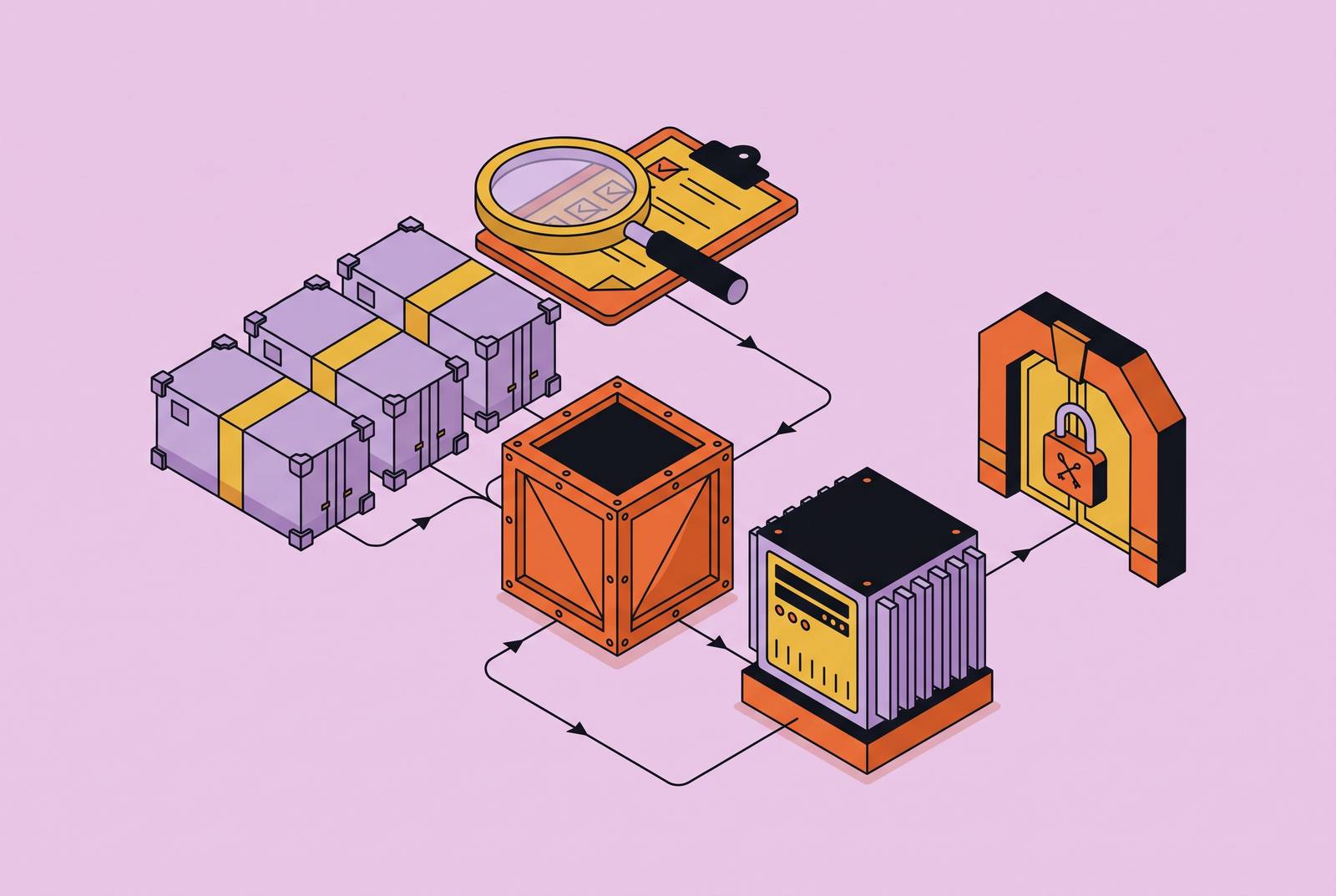
The full chain of evidence auditors require runs from known source through controlled change, known dependencies, reproducible build, protected signing, verified artifact, approved promotion, and observable deployment. Each link depends on the previous one being trustworthy. No single control delivers this chain alone, and the chain cannot be assembled retroactively because the links depend on properties that only exist at build time.
How platform engineering teams embed these requirements into the developer path rather than bolting them on
The sustainable way to satisfy supply chain audit requirements at scale is to encode them into the paved path that developers use by default. Generating a compliant SBOM, producing a signed provenance record, and running in a hermetic environment must be natural outputs of the standard build workflow, not extra steps. Onboarding a new developer or a new CI node produces the same declared environment rather than a best-effort approximation.
In regulated industries, the platform engineering investment pays a compliance dividend. The evidence that satisfies FedRAMP CM-8, SR-4, and RA-5 is generated automatically as a side effect of how teams build, rather than assembled before an assessment. The platform must make the hermetic, provenance-generating build the default, not an opt-in.
Extensible base environments, maintained by platform engineers and pulled by development teams, are the organizational mechanism for ensuring that the declared environment is always current, always compliant, and always the same across developer laptops, CI, and production. When a CVE requires a patch, the platform team updates the environment, all downstream teams pull the new version, and the hash change is auditable as a single event rather than a distributed remediation effort across individual CI configurations. The teams best positioned for FedRAMP 20x's automated evidence requirements are those that have already made compliant builds the default path, not those scrambling to generate evidence before an assessment.