Nix Overlay Strategy for Expedited Security Patches
Use Nix overlays to patch CVEs before upstream fixes ship.
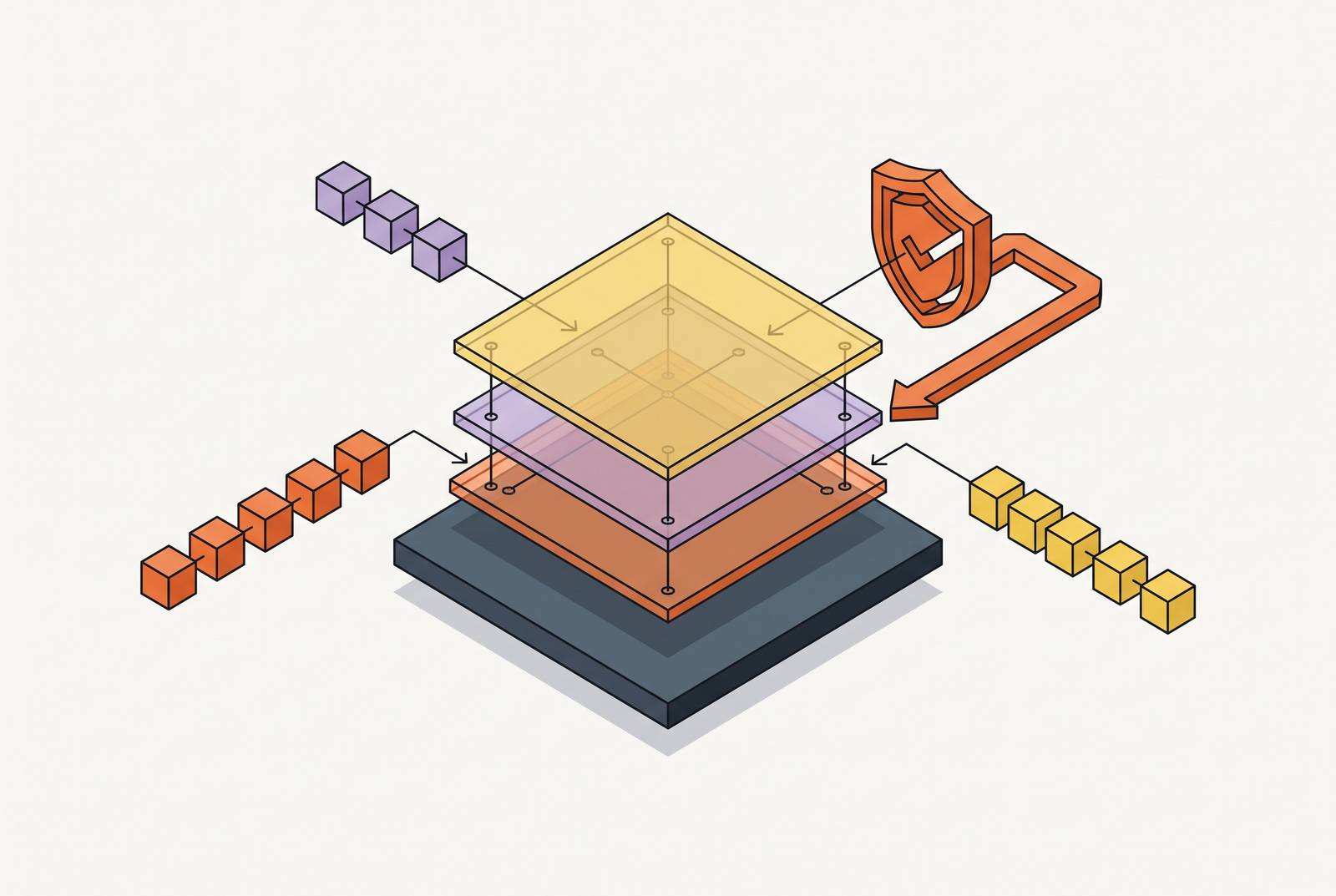
A disclosed CVE with no shipped fix is a window of known, documented risk, and that window widens with every handoff in a traditional patch pipeline. A vulnerability disclosure lands, a maintainer packages a fix, the change clears review, and the fix finally ships in the next channel release. Each step happens in sequence, and each one sits outside the control of the team actually exposed to the vulnerability. Each option is bad: wait and stay exposed, ship with a live CVE in production, or apply a manual workaround that nobody documents and nobody can reproduce on the next machine. The problem recurs even inside the tool that promises to solve it: CVE-2026-39860, a vulnerability in Nix itself with a CNA base score of 9.0, carried fixes across versions 2.34.5, 2.33.4, 2.32.7, 2.31.4, 2.30.4, 2.29.3, and 2.28.6, so the wait for an upstream fix applies all the way down to the build system a team relies on to escape it.
Nix Derivations, Closures, and Sandboxing: Conditions for Surgical Patching
Nix's advantage over conventional package management is architectural. A derivation is a fully introspectable build instruction: every input, every build step, and every output is written down and inspectable before a single byte compiles. Builds run inside a sandbox with no arbitrary network access and no arbitrary filesystem access, so a build can only use what it was explicitly given. A closure captures the complete dependency graph behind a package, build-time and runtime both, so nothing enters a system through a side door. Nix treats a package as a pure function of its inputs: the same inputs always produce the same output, and that determinism has a direct security consequence. Changing one input, such as a patched source file, changes the output in a way that is deterministic and verifiable. None of that matters without a way to pin the environment in time, which is the job the flake.lock file does: it records the exact nixpkgs commit SHA a build was evaluated against. A patched environment reproduced six months later, on a different machine, in a different country, resolves to the same closure as the one originally validated. That pinning is the guarantee that turns a security fix into something durable rather than a one-time situational patch applied under pressure and forgotten.
Overlays as the Primitive for CVE Response
An overlay is the mechanism that lets a team act on the architecture described above without waiting for anyone else. Overlays let a team programmatically extend and replace existing package recipes, including overriding a package's src, its patches, or its build attributes, ahead of whatever the upstream channel eventually ships, without forking Nixpkgs and without touching any package the team doesn't care about. Overlays are a first-class architectural feature of Nixpkgs itself, the same mechanism behind established overlays like nixpkgs-mozilla. Practitioners describe the ability to programmatically extend and replace existing recipes as "an underrated super-power," and the CVE workflow built on that power is straightforward. A team identifies the affected derivation, writes an overlay that overrides its src or applies a patch directly, pins the patched nixpkgs revision in flake.lock, and pushes the change. Every package in the dependency graph that depends on the patched component rebuilds automatically, driven by the new input hash rather than by a human remembering to touch each downstream package. That automatic propagation is the overlay's real advantage over a conventional package manager, where patching a shared library means finding, rebuilding, and redeploying every dependent package one at a time. In Nix's closure model, dependents rebuild as a direct consequence of the patched input changing, not as a separate manual project. The applicative-systems secure-supply-chain demonstration shows this working at production scale: a NixOS image carrying C++ and Rust services, with every source input verifiable and the entire image rebuildable offline from a source closure. That same closure integrity is what makes an overlay patch auditable rather than a change nobody can trace back to its origin.
The overlay maintenance trap: how emergency patches become permanent forks
The mechanism that makes overlays fast is also the mechanism that makes them dangerous to leave unattended. Patching in Nix is, by the admission of practitioners who do it daily, potentially "too easy." Because an engineer can override a src attribute and ship a fix in minutes, overlays accumulate, and nothing in the mechanism forces anyone to retire one once its job is done. Left unmanaged, an overlay silently diverges from upstream in exactly the way the Nix model is supposed to prevent. A practitioner account from the research describes patching ten to twenty upstream bugs at a previous job, working alongside a coworker and putting in real effort to get those patches merged back upstream. Even so, the account continues: "sometimes we built load-bearing code on top of those patches while upstream ended up with a different API." At that point the overlay quietly becomes a permanent local fork, invisible until it breaks the next upgrade. The same practitioner describes the pattern recurring at the personal level too, "carrying around patches in my configuration repo and forgetting about them until years later when they break an upgrade." When that habit scales to an organization, the failure mode is a security overlay that was applied under pressure during an incident, never linked to an upstream resolution, and left to fossilize in a configuration repo until someone's unrelated upgrade breaks on it months or years later. An overlay applied specifically to remediate a CVE can become, through nothing more than neglect, the exact category of undocumented divergence that Nix-based environments exist to eliminate.
Governing overlays so patches stay temporary and upstream resolution is tracked
Treat an overlay applied for CVE remediation as a time-bounded debt. That means three concrete things attach to the overlay at the moment it's written: a linked upstream issue tracking the real fix, an expiry condition defined as the upstream version that resolves the CVE, and a removal step that is itself part of the remediation record, not an afterthought left to whoever notices the overlay later. The ecosystem is building infrastructure to support exactly this discipline. The Nixpkgs Security Tracker, funded through Tweag on behalf of a client, offers subscription and notification for registered maintainers, per-package CVE feeds, and a workflow for bundling related CVEs into a single tracking issue. The design intent, in the words of the project's maintainers, is that "maintainers would only need to update the version once to the one that has them all fixed." That single version bump is the upstream resolution event that should trigger an overlay's retirement on the team side. At the team level, overlay governance works best as a small set of concrete habits: name each overlay after the CVE it addresses, add a comment recording the upstream version that fixes it, wire overlay retirement into the same CI pipeline that bumps the nixpkgs revision, and treat any overlay still present after upstream has shipped its fix as a failing check, not a cosmetic warning. None of this requires new tooling beyond what a CI pipeline already runs. It requires treating an overlay as a tracked obligation with a defined end, the same way a team would treat a feature flag left in production past its intended lifespan.
The Nixpkgs Security Tracker and sbomnix: Closing the CVE-Discovery-to-Overlay Loop
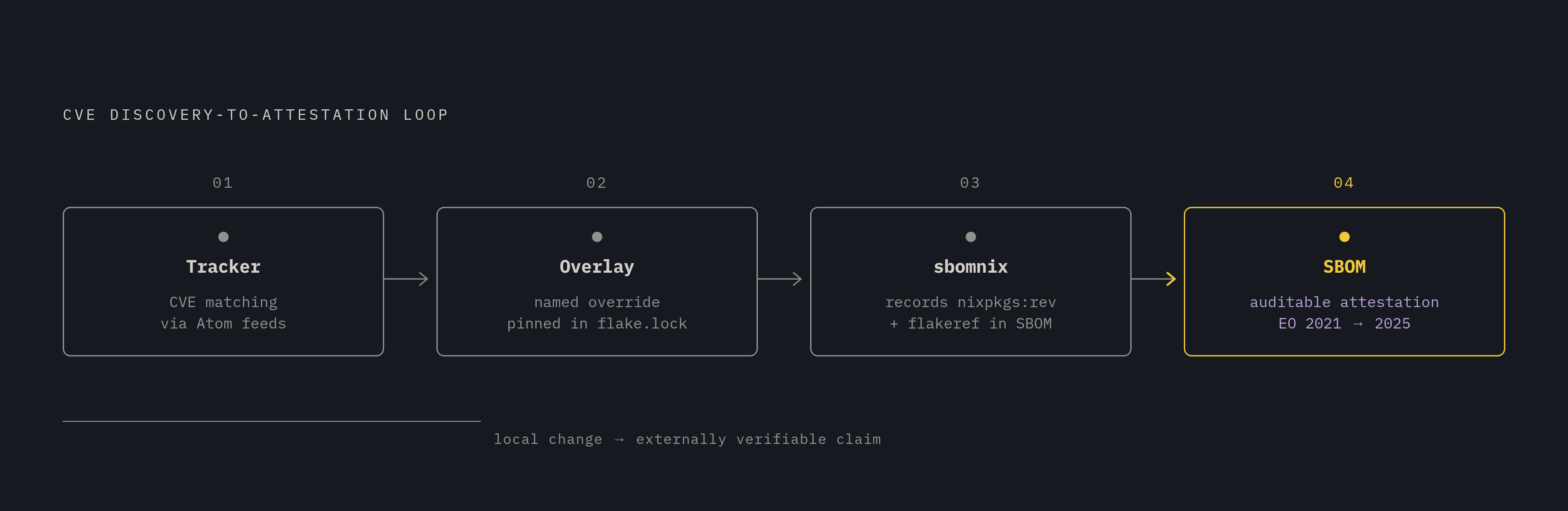
Every part of the overlay strategy described so far assumes a team already knows which package needs patching, and that assumption is the weakest link in the chain. A team cannot write an overlay for a vulnerability it doesn't know exists, and knowing requires mapping the versions of packages actually running against the universe of known CVE identifiers, a problem Nix's closure model is structurally well suited to solve but one the ecosystem has historically underinvested in. The Nixpkgs Security Tracker addresses this directly: automated matching of CVEs against Nixpkgs derivations, per-package vulnerability feeds delivered over Atom, and structured dismissal reasons for matches that turn out not to apply. That gives a team a machine-readable signal of what in its dependency graph is vulnerable, in place of a changelog to read by hand. The verification side of the loop is handled by a separate tool, the tiiuae sbomnix project, which at version 1.8.0, released June 9, 2026, produces CycloneDX and SPDX output recording nixpkgs:rev, nixpkgs:flakeref, and nixpkgs:version fields directly in the SBOM. That makes the exact nixpkgs revision a build was produced from part of the permanent record, not a detail that lives only in a deploy log. A production implementation of this pattern appeared in September 2026 in seradotcom's semwright project: nixpkgs pinned to an exact revision, release executables built through a Nix derivation, reproducible per-binary CycloneDX 1.5 SBOMs generated twice and compared byte-for-byte, with deterministic certification bundles produced on both x86_64 and aarch64. The byte-for-byte comparison is the step that matters most here: it proves the build is reproducible. Put together, these pieces close the loop end to end. The Security Tracker identifies which packages need an overlay, the overlay changes the input hash, sbomnix records that new hash in the SBOM, and the SBOM stands as verifiable proof the CVE was remediated rather than a spreadsheet someone updated by hand and might forget to update again.
Patching a Nix Package Is Also Patching a C, Python, Go, or Rust Package
A Nix package is almost always an upstream artifact wearing a Nix wrapper, and that fact has a direct consequence for how vulnerability tracking has to work. A derivation that builds a Python library is still a Python package as far as the CVE database is concerned. One that compiles a Go binary is still a Go module. A C library packaged through Nix still carries its own CVE history mapped to CPE identifiers, and nothing about the Nix layer changes what the NVD or OSV databases know about that underlying component. This is the gap sbomnix's metadata fields are built to close: by recording the upstream package identity alongside the Nix revision in the same SBOM, the record produced after an overlay patch can be matched against CVE feeds that speak in upstream coordinates. The practical consequence for overlay strategy follows directly. The patch target gets identified by its upstream CVE identifier, the overlay itself operates at the level of the Nix derivation, and the SBOM is what bridges those two vocabularies. That bridge is what makes a remediation traceable end to end, in language a security team and an external auditor can both read without needing to understand Nix's internals first.
What the Regulatory Environment Makes Non-Negotiable About SBOM-Backed Patch Verification
The regulatory requirements around software provenance have built on each other steadily since 2021, and each addition has raised the evidentiary bar for what "patched" is allowed to mean in a compliance context. A federal executive order, issued in 2021, required software vendors selling to the US government to provide SBOMs, with the implementation details delegated to agency guidance that followed. A federal memorandum, issued in 2022, laid out guidance tied to a government secure software development framework. CISA issued a formal self-attestation form in 2024. A follow-up federal executive order, issued in 2025, expanded attestation and storage requirements further. An overlay without an SBOM attached to it is a local fact, true inside one team's repository and nowhere else. An overlay backed by a reproducible, hash-pinned SBOM is an auditable claim, and that claim is visible directly in an audit conversation: telling an auditor "we patched it" against showing the auditor the exact derivation input that changed, the hash that resulted from that change, and the SBOM record that ties the two together. The overlay mechanism gives a team the speed to patch ahead of any upstream release schedule. The SBOM layer built on sbomnix and tools like it gives that same team the proof an auditor, a regulator, or a customer's security team will eventually ask for.
Sources
- Nixpkgs supply chain security project - #35 by fricklerhandwerk - Announcements - NixOS Discourse
- Nixpkgs supply chain security project - Announcements - NixOS Discourse
- Nixpkgs security tracker
- How to patch in an overlay - Help - NixOS Discourse
- Nix: A Solution With Problems
- CVE-2026-39860 Detail - NVD
- Nixpkgs/Patching Nixpkgs - Official NixOS Wiki